2020년 3월 31일 화요일

02.07 - 별 생의 종말(End of a Star's Life)

02.07 - 별 생의 종말(End of a Star's Life) [커세라 강의페이지]


Within this module, we have looked at the birth and life of stars. We have explored the stellar nurseries and discovered that stars, just like humans, walk different paths. Yes, we all eat, sleep, and explore life, or in the case of a star, burn fuel and shine bright. However, just as there are different paces of life for us humans so too can stars live and die in many different ways. Now that we know the basics, let's explore the life of rock stars and that of average joes, in the stellar sense that is. Let's see how different stars move towards the end of their lives.

인간의 삶이 그렇듯 별의 생도 저마다 살아온 여정이 다르다. 먼저 아주 평범한 별부터 삶과 죽음에 이르는 과정을 따라가 보자.

Here we will discover that the life and subsequent death of a star are determined at birth by the star's mass. But how can this be the case? The story of a star's death begins at the point at which it leaves the safety and security of the main sequence. The main sequence is the long main track observed in the Hertzsprung Russell diagram.

별의 삶과 죽음은 태어날 때질량으로 결정된다. 별이 태어나서 (별이라고 불릴) 안정된 시기는 허쯔스프렁-러셀도상의 주계열 선상에 머무를 때다.

We have learned that stars seen in the upper left of this track burn hot, blue, and are massive, weighing 10 to 100 times the mass of our sun, or possibly more. Stars at the lower right of the track are cool by stellar standards. They are red and may only contain a tenth of the mass of our sun. We have also learned that blue stars tend to be called high mass, while stars like our sun and smaller are often called low mass stars.


주계열의 좌측상단에 위치한 별들은 태양보다 100~100배 혹은 그 이상 무겁고 뜨거운 청색별들이다. 주 계열의 우측하단에 위치한 별들은 적색의 차가운 별들로 태양의 1/10 가량의 질량을 갖는 별이다.

When a star leaves the main sequence of the Hertzsprung Russell Diagram, the star is seen to move towards the right of this plot. This movement is the result of the star becoming redder. But what does this change in color represent? What changes in the star's interior are powering the shift? And what happens in the time between the departure from the main sequence, and the star's demise? This is what we are about to explore.

HR도의 주계열을 떠나면 오른쪽으로 이동하게 되는데 별들의 표면 색이 적색으로 변한다. 표면색의 변화는 무었을 나타내는 것일까? 별내부에 동력 변화가 발생한 이유는? 주계열에서 벗어나 죽음에 이르는 동안 별들은무슨 일을 겪을지 알아보기로 하자.

[무겁고 뜨거운 별일수록 급격히 변한다. 청색에서 적색으로 색변화만으로 과학자들은 많은 것을 추적하고 밝혀냈다. 무려 수천만년에서 백억년에 이르는 별의 생을 밝혀낸 것은 최근 몇 십년 사이에 이룬 과학적 업적이다. 물론 여전히 신비에 쌓여 있는 부분이 많다. 블랙홀을 부정하진 않지만 본 사람이 없으니까.]

When a star's core runs out of hydrogen fuel, the core can no longer sustain the outward radiation force that balances the force of gravity, which is pulling everything inwards.

별내부의 수소를 소모하여 헬륨이 쌓이고 핵융합이 줄어들게 되면 밖으로 향하는 복사와 중력의 균형이 깨지기 시작한다.

Therefore, the star will no longer be in hydrostatic equilibrium. This loss of radiation pressure results in the stars core collapsing. The collapse of the core in turn causes the temperature of the interior to increase.

복사압이 모자라서 정역학 균형이 깨진별은 중력에 의해 수축되기 시작한다. 중력수축은 다시 별 중심의 온도를 올린다.

When a star burning primarily hydrogen suffers from such a collapse, it will contract until the core reaches about 100 million degrees. At that temperature, the star can begin to burn helium in its core. Helium will become the main source of energy for the star at this point, as it fuses to create carbon and other trace elements.

처음 수소를 태울 때 복사압으로 중력 수축을 막아냈으나 이제 중력 수축으로 인해 중심온 도가 1억도 까지 오른다. 수소 핵융합은 1천 5백만도 였다. 마침내 헬륨을 쓰는 핵융합이 시작된다. 헬륨이 핵융합하여 탄소를 만든다.

However, if we look just outside the helium core, we can see that the core is surrounded by a shell of hydrogen that is also burning. This hydrogen shell is slowly consuming more material as it moves outward through the star.

하지만 헬륨핵융합이 일어나는 중심부를 둘러싸고 수소 핵융합이 진행되고 있다. 수소핵융합 껍질은 서서히 외곽으로 번진다.

Start transcript at 3 minutes 21 seconds3:21
As the helium burns hotter than its predecessor, the hydrogen core, it burns more rapidly, therefore this phase of the star's life is shorter.

중심부의 헬륨 핵융합도 이전의 수소 핵융합 보다 훨씬 높은 온도에서 이뤄진다. 태우는 속도가 매우 빠르기 때문에 수명도 짧다.

Start transcript at 3 minutes 31 seconds3:31
Once the helium core is exhausted, the core will once again collapse.

중심부에서 헬륨마저 떨어지면 다시 수축한다.

Start transcript at 3 minutes 37 seconds3:37
As it collapses, the temperature will once again increase.

이 수축으로 중심의온도가 올라가고

Start transcript at 3 minutes 42 seconds3:42
If the collapse leads to a temperature of 600 million degrees, the star is able to burn carbon. Such a core would be surrounded by both helium and hydrogen shells. Once the carbon burning is complete, the cycle can again repeat, leading to neon, oxygen, and even silicon burning, with the core becoming heavier and heavier.

거의 6억도에이르면 탄소를 태우는 핵융합이 시작된다. 중심에서 탄소 핵융합이 이뤄지는 동안 헬륨과 수소 핵융합의 껍질은 지속적으로 외곽으로 번진다. 중심의 탄소도 소진되면 중력 수축으로 인한 온도상승 더무거운 원소의 핵융합으로 이어진다. 탄소 다음은 네온, 산소, 심지어 실리콘을 태우면서 중심부는 점점 무거워진다.

Start transcript at 4 minutes 8 seconds4:08
As each layer is hotter than the last, the star burns through the core more rapidly. For example, a star could take billions of years to burn through its hydrogen whilst it may only take hundreds of years to feed on a carbon core. By the time we reach silicon, it's possible for a star to consume its core in about a day.

무거운 원소를 태우기 위해 핵융합의 의의 온도가 높아지고 그 기간은 매우 짧다. 수소핵융합이 백억년에 걸쳐 진행되는 반면 탄소 코어는 수백년이면 끝난다. 심지어 실리콘은 소진하는데 하루밖에 걸리지 않는다.

The multiple layers of a star seen here have led to these stars sometimes gaining the nickname of onion stars as onions have layers, just like ogres, or cakes, or parfaits. Everybody likes parfaits. Where was I? Back to stars. Yes, they have layers. Okay, but it all stops with iron. When learning about fusion and fission we discovered that the most tightly bound atom is iron and that no more energy can be gained by either breaking iron apart or by smashing two iron nuclei together.

더 무거운 원소 태우기의 끝은 철(Fe)이다. 앞서 핵반응 강의에서 봤듯이 철의 원자 결합 에너지가 가장 강하다. 두 철 원자를 으깨서 다른 핵으로 만들어 낼 만큼의 강력한 에너지 원이 없기 때문이다.

As a result, there is no fuel left for the star to burn through. Fusion in the core must stop and the star will die. We will explore more of the death of stars in the next two videos.

더 이상 태울 것이 없으면 별은 죽는다. 별의 죽음은 다음편 강의에서 다룬다.

------------------------------------------------------------------

Meanwhile... So far we have been looking at what's going on inside the star, but what effect does that have on the outside of the star? Or rather, what effect does that have on what we can see? When stars run out of the current fuel in their core, we discovered that the cores collapse. This continues until the star is able to burn a new type of fuel. So for example, when a star initially runs out of hydrogen, it will collapse until the helium fires begin to burn.

Start transcript at 5 minutes 53 seconds5:53
What effect does this have on the envelope of the star?

별 중심부에서 수소 핵융합이 끝나고 중력 수축 되는 시기로 돌아가 보자. 중력수축으로 인해 헬륨 핵융합이 개시되려고 한다. 이때 별의 외곽은 어떤 모습일까?

Start transcript at 5 minutes 58 seconds5:58
The envelope is the outer hydrogen rich region of the star, which is not involved in nuclear fusion.

외곽은 핵융합과 무관한 수소들이 아주 풍부하다.

Start transcript at 6 minutes 6 seconds6:06
It is the outer layer of the star. Well, as the core collapses the energy generated by this collapse drives the diffuse envelope outwards and so the star expands.

중심부에서 한 핵융합이 끝나면 수축하여 새로운 핵융합이 시작되는 반복을 거듭하고 아울러 타던 껍질이 외곽으로 번지면서 표면이 팽창한다.

Start transcript at 6 minutes 19 seconds6:19
As it becomes less dense it cools and so it reddens.

그 팽창으로 밀도가 낮아지며 냉각되어 적색으로 변한다.

Start transcript at 6 minutes 24 seconds6:24
This means that we would see the star appear to grow in size while becoming redder.

Start transcript at 6 minutes 30 seconds6:30
If we return to the Hertzsprung Russell diagram, we will see that this means that the star leaves the main sequence and becomes either a red giant or a super giant.

허쯔스프렁 러셀도에서 주계열을 떠나 붉고큰 적색 거성으로 변하는 단계를 볼 수 있다.

Start transcript at 6 minutes 42 seconds6:42
This expansion and reddening happens each time the core runs out of fuel and searches for a new source of food.

이런 팽창과 적색화는 별의 중심에서 새로운 연료를 찾는 중이라는 증거다.

Start transcript at 6 minutes 50 seconds6:50
As a result, the stars can move great distances from the main sequence over time. However, as a star lives most of its life on the main sequence, it is the loss of hydrogen in the star's core that is the easiest to mark.

Start transcript at 7 minutes 5 seconds7:05
A star's departure from the main sequence is known as the star's turnoff.

별은 수소를 태우며 생의 90%를 보내다 주계열에서 멀어진다. 별이 주계열을 떠나는 지점을 이탈점(turnoff)이라한다.

Start transcript at 7 minutes 12 seconds7:12
What kind of size difference would we expect to see, though?

별의 크기에 따른 변화의 양상이 어떻게 달라질까?

Start transcript at 7 minutes 16 seconds7:16
Well, in the case of our sun, we'd expect that the surface of the sun would reach out and swallow the Earth, possibly even extending out to Mars. We don't need to worry though. We have about 5 billion years before this is going to happen. So we have a little more time to crack the problem of space travel, and venture out to explore the universe before our sun dies. You never know. We might come back to watch the death of our sun on the day 5.5/Apple/26 as they did on Platform One in the Doctor Who episode The End of the World.

태양의 경우 표면은 지구를 삼키고 어쩌면 화성궤도까지 팽창할지도 모른다. 태양의 팽창은 지구의 종말을 맞는 셈이다. 이렇게 팽창하기 까지 50억년 남았다.

Start transcript at 7 minutes 52 seconds7:52
So what about stars other than our sun? How will their mass affect their lifespan? How will their life and their lifespan be affected by the fuel that they burn?

태양의 다른 별들, 더 무거운 별의 수명은 얼마나 다를까? 핵융합 연료의 양이 다름에 따라 수명은 달라진다. [하지만 무거운별은 중력수축에 의한 열에너지 발생이 높아서 핵융합로의 규모가 커진다. 결국 더 맹렬히 태우는 덕에 오히려 주계열 수명이 짧고 종말의 순간은 찬란해 진다.]

Start transcript at 8 minutes 3 seconds8:03
If we start by considering the life of an average Joe, that is to say a low mass star. They can spend 10 to 100 billion years on the main sequence slowly burning through their hydrogen cores. At the end of this time, they will depart the main sequence, obtaining their middle age spread before puffing up to become red giants.

아주 평균적인 주계열별부터 따져보자.이 별은 주계열에서 1백억년에서 1천억년 가량 머문다. 핵에서 수소를 아주 천천히 태우기 때문이다. (핵융합로의 크기가 작다.) 이런 별들은 주계열 근처에서 중년을 보내다가 적색거성으로 끝낸다.

Start transcript at 8 minutes 28 seconds8:28
In this phase of a low mass star's life, an average Joe will carry on, plodding along, as it slowly consumes its helium core. At this point, the core will collapse but will never reach a temperature that is hot enough to ignite its carbon fires. The star will instead end its life quietly, missed only by its family of planets, and its close friends.

가벼운별은 적색거성 단계에서도 헬륨핵의 핵융합도 천천히 진행된다. 아울러 중력수축도 서서히 진해되기 때문에 탄소 핵융합을 시작할 만한 온도에 이르지 못한다. 결국 조용한 결말을 맺는다.

Start transcript at 8 minutes 51 seconds8:51
But what about the rock stars, the high mass stars? What path do these stars take? High mass stars, like many well known rock stars, live fast and die young, in a huge explosion. Explosions so massive that they can be witnessed in other galaxies.

하지만 활기왕성한 무거운 별의 경우 어떤 경로를 따르게 될까?격정적으로 살다가 단명한다. 그리고 대폭발로 끝맺는다. 그 폭발의 규모는 실로 엄청나서 다른 은하에서도 관찰될 정도다. [타은하에 속한 초신성 폭발을 관측하여 거리 측정의 기준으로 삼을 정도다.]

Start transcript at 9 minutes 10 seconds9:10
The rock stars in the stellar nursery are more massive, and so contain more hydrogen. But they are also much hotter. High mass stars burn through their hydrogen cores at a much faster rate departing the main sequence after only maybe a million years.

태어날 때부터 무거운 별은 더 많은 수소를 가지고 있고 더 뜨겁다. 핵에서 더 빨리 태우기 때문에 주계열에 머무는 시간은 약 백만년에 불과하다.

Start transcript at 9 minutes 29 seconds9:29
At this point the high mass star will switch to burning helium, then carbon and so on building up multiple layers. The number of layers the onion star builds up depends on its initial mass. The more massive the star was at its birth, the closer it can get to an iron core.

무거운 별이 주계열을 떠날 때쯤 내부에서 헬륨을 태우기 시작하고 이어서 탄소를 태우며 다른 핵융합 층을 형성하게 된다. 몇 개의 핵융합 층을 형성하게 될지는 최초의 질량에 달렸다. 가장 무겁게 시작한 별의 중심에 철이 쌓인다.

Start transcript at 9 minutes 49 seconds9:49
During this time, our rock star will go through a giant, and possibly even a super giant phase as the outer envelope swells, before our rock star eventually dies. The explosive nature of a rock star's ending is explored in more detail later in this module.

무거운별이 이쯤되면 거성이 되고 폭발에 이를지도 모른다. 폭발로 마감하는 별에 대해서 다음 강으에서 다를 것이다.

Start transcript at 10 minutes 10 seconds10:10
Our average Joes and our rock stars were all born in the same stellar nursery. These stars were all born around the same time and yet live very different lives at very different paces. By taking measurements of stars to obtain their color and brightness, we are able to learn more about where the star is in its life cycle.

평균의 별도 같은 곳에서 태어난다. 별들은 모두 같은 장소에서 태어나지만 (태어날때의 무게에 따라) 그 삶의 궤적은 제각각이다. 별의 색과 밝기를 측정하여 그 별의 생에 대해 많은 것을 알 수 있다.

Start transcript at 10 minutes 33 seconds10:33
However, we can also use this information to find out about the stars that came from the same nursery.

Start transcript at 10 minutes 41 seconds10:41
If we take measurements of lots of stars from any given cluster, and when I say cluster, I mean all the nursery graduates that are still around. We can create a Hertzsprung-Russell diagram for that cluster. This will provide us with a clear view of the current turnoff, the main sequence, within that cluster.

성단(cluster)은 별이 무더기로 태어난 곳이다. 이 성단에 속한 별들을 가지고 헤르쯔스프렁 러셀도를 그려보면 별이 주계열을 이탈하는 과정을 아주 분명하게 알 수 있다.

Start transcript at 11 minutes 4 seconds11:04
If we check what types of stars are currently turning off, we are able to determine how long they would have been living on their diet of hydrogen in their cores.

어떤 종류의 별이 현재 이탈 중인지 조사하여 별마다 중심에서 얼마나 오랫동안 수소 연료를 소모하는지 알 수 있다.

[성단에 속한 별들은 비슷한 시기에 태어났다고 간주하자. 태어날때 질량에 따라 다양한 종류의 별이 모여 있다. 게다가 성단 내의 별들은 모두 같은 거리에 있다고 볼 수 있으므로 색과 겉보기 밝기만으로 정확한 HR도를 그릴수 있다.]

Start transcript at 11 minutes 15 seconds11:15
This will tell us the age of the cluster.

아울러 성단의 정확한 나이를 알 수 있다.

Start transcript at 11 minutes 19 seconds11:19
By taking the measurements of multiple stars, we can tell if this was the graduating class of 100 million, a billion, or even 10 billion years ago. If a cluster is still very blue, then it must be young, while a redder cluster will be old.

파란 별이 많으면 아주 젊은 성단이다. 적색계통의 별이 많으면 늙은 성단이다.

Start transcript at 11 minutes 37 seconds11:37
Clusters of stars change color with age, just as stars do. The hotter bluer stars die out first, then the average stars and finally, the red dwarfs. Eventually all stars die off, resulting in a production of elements that can feed into the next generation of stars. This stellar death is the next avenue to be explored in our journey through the life and death of a star.

성단은 나이에 따라 색이 변한다. 뜨거워서 파란 별들이 먼저 죽는다. 평균의 별들은 적색왜성으로 생을 마감한다. 별이 죽으면서 다른 별이 태어날 연료를 제공한다.

---------------------------------------------
[처음][이전][다음]

2020년 3월 29일 일요일

02.06 - 햇빛과 지구생명(The Sun's Light and Life on Earth)

02.06 - 햇빛과 지구생명(The Sun's Light and Life on Earth) [커세라 강의페이지]


Do not look directly at the sun. The sun is bright, and our squishy, liquid-filled human eyes have evolved for use in an average solar irradiance environment. That's a mouthful. But the lesson is simple. Do not look directly at the sun even using sunglasses. Doing so can permanently damage your eyes and your ability to see. In extreme cases, you may become permanently blind.

절대로 태양을 직접 봐서는 않된다. 실명할 수도 있다.

There are safe ways to look at the sun. Either by reducing the total light that we observe with our eyes or by narrowing the spectrum of interests into a short range of colors. Common light reducing tools are the number 14 welders glass, or an astronomy-specific pair of solar sunglasses like this.


용접용 차단 필터를 쓰거나 연구를 위해 특정 파장만 통과 시키는 필터를 통해 해를 바라보자.

Now, that we're finally equipped to look at the sun, let's go ahead and have a look. Wow! The sun's surface which is called the photosphere is a roiling inferno of activity.


우리가 보는 태양은 광구(Photo-Sphere)라고 한다. 회전하는 지옥불덩어리다.

Bright patches mottle the surface separated into small cells by darker boundaries. Once in a while, you encounter a very dark patch, a sun spot.


쌀알 무늬(Granule)와 가끔 흑점 (Sunspot)이라고 하는 큰 검은 점도 보인다.

If you look closely, you can also see hot gases above the Sun's surface following magnetic field lines.


자세히 보면 자기장을 따라 솟구치는 가스 불기둥도 있다.

Every detail we see on the surface of the Sun is the result of the thermonuclear reaction at the core. The photons that eventually escape from the surface of the sun are not the same ones that began the journey in the nuclear furnace at the stellar interior.

Although the energy was produced by fusion, that energy went through several stages in its 100,000 year journey. The most notable was the journey through the convective zone, where our photons energy was locked away in the vibrations of the hydrogen and helium gases as they floated to the surface.


Once exposed to the vast vacuum of space, the heat energy contained within those vibrations can now escape freely as photons. Since these photons originate from hot dense gas, they're mostly the result of blackbody radiation.


Some sprinklings of atomic hydrogen emission and absorption are present in the Sun spectrum. But the dominant component of the spectrum is the result of the Sun's surface temperature. Since we can measure what the peak wavelength of the Sun's blackbody emission is, we can use Wien's law to calculate the average surface temperature of the Sun as well. Since the Sun's peak wavelength is about 500 nanometers, which is to say a yellow greenish color, we'll plug that number into Wien's law in order to calculate the surface temperature.


The Sun's surface temperature is equal to Wien's constant 2.898 times 10 to the negative 3 divided by the peak wavelength 500 nanometers. Which results in a temperature of 5,796 degrees Kelvin.


The fact that the Sun does not look green, when in fact it has a peak emission in the wavelength of green, is due to the fact that the Sun also emits a lot of red and blue light, and when you combine red, green, and blue light, we observe it as a white light.

But what about this strange pattern on the surface of the Sun? What causes this pattern to emerge? These are called solar granules, and are the result of the convection in the photosphere.


Hot gases rising from the stellar interior are visible as bright patches of yellow. But what happens to them once they're at the surface? At the surface, these gases emit light, and in doing so, cool down.  The cooler gases are now more dense, and therefore less buoyant, and they begin descending in the zones at the boundaries of the hotspots. These cooler gases are visible as the grain-like boundaries on the Sun's surface, and this is where the cool gases begin their descent.

The Sun's photosphere is a layer of gas that becomes cooler in the outermost layers. This image of the Sun's visible light shows all the colors of the rainbow and corresponds to blackbody emission from the lowest region of the photosphere. As the light travels outward through the photosphere, some of the light with special colors, is absorbed by the cooler hydrogen gas and other elements present in the atmosphere. When the light is absorbed at these colors, we see black lines instead of that color. We call this an absorption spectrum.


The Sun doesn't just produce good old-fashioned visible light. Wien's law tells us that it also produces high energy UV radiation and X-rays too. These images come from NASA's Solar and Heliospheric Observatory called SOHO for short, and show the Sun at wavelengths that our eyes can't see. This image for example, was taken with a peak wavelength in the ultraviolet, or a 19.5 nanometers. Revealing even more of the stellar atmosphere that wasn't visible to the naked eye. Not only that, but in the UV, there's much more contrast. So, activity in and above the photosphere is much more apparent.


The outermost regions of the Sun's atmosphere are called the chromosphere and the corona. The corona is much hotter than the Sun's surface, which scientists think is a result of the tremendous energy contained within the magnetic fields that are generated by the Sun.


---------------------------------------------

The energy produced at the core of the Sun is the same energy that nearly all of life depends on. From the water cycle to the web of life, the majority of the energy required to sustain all plant and animal life on Earth, comes from the Sun. The energy that we release when we burn hydrocarbon-based fuels, can be traced back through geological time to a moment when an ancient plant absorbed light from the Sun. Which eventually contributed to coal seams and oil wells where we derive the fuel for our modern life. This is contrasted by modern renewable fuel sources like solar energy that convert direct sunlight into electricity. In a sense, almost all energy sources can be considered solar energy.

We happened to be in a relatively stable energy environment around the Sun. If Earth were closer to the Sun, like Mercury and Venus, it would be much too hot for life to exist as we know it. Similarly, if Earth were farther away from the Sun, like Mars's orbital radius, it would be much too cold for most of life to survive. Asking where a planet can have liquid water, or more importantly, the conditions required to sustain life, is a fundamental question that many scientists have asked throughout human history.


Astrobiologists, people who study both astronomy and biology call this region the habitable zone. Generally speaking, the habitable zone is a region surrounding a star where a planetary body like Earth would be able to support liquid water. There is some flexibility in this definition since it would include frigid planets where the maximum temperature is just above the freezing point of water and intensely hot planets whose minimum temperature dips just below the boiling point of water. Let's look at our own solar system and see where we would draw the boundaries of the habitable zone. Scientists believe that our own solar systems habitable zone extends as close to the sun as Venus at just under three quarters of an astronomical unit, to as far as twice Mars's orbit or twice 1.5 AU.


Arguments vary regarding what we consider normal life. Since we have examples here on Earth of extremophiles that can live at extreme temperatures. So, we'll just have to leave the boundaries of the habitable zone as what they are, estimates. What if Earth were in orbit around a different type of star instead of the G-type star we currently orbit? An M-type star like our nearest stellar neighbor Proxima Centauri, are cooler, red dwarf cousins of our own Sun. Since they have a lower surface temperature, the habitable zone around has to contract to smaller distances. If Earth's stayed at the same distance from an M-type star like this, it would quickly turn into an icy snowball at the edge of the new habitable zone. On the other hand, if the Sun were suddenly replaced with a more massive and therefore higher temperature star, like a blue blazing B-type star Bellatrix, the habitable zone would move outward in the solar system leaving Earth a burnt crisp. Similar effects can happen as stars age as well.


As stars move off the main sequence, they enter a series of stages where luminosity and radius tend to increase. We'll see more about this in the next section.

-----------------------------------
[처음][이전][다음]

02.05 - 별의 에너지 손실(Energy Loss from Stars)

02.05 - 별의 에너지 손실(Energy Loss from Stars)


At the core of all stars, there's a glowing nuclear furnace. We can be sure of this because we can measure how many neutrinos are streaming out of the sun with experiments like the Sudbury Neutrino Observatory. This property of neutrinos, that they can pass through the core of the star virtually unimpeded, is because neutrinos are weakly interacting particles. Which is to say that they do not interact with electromagnetic forces. Light particles or photons do interact electromagnetically and thus they have a very difficult time leaving the core of a star.


모든 별의 중심부는 핵융합로다. 얼마나 많은 중성미자(neutrino)가 방출되는지 측정하면 핵융합로의 규모를 알 수 있다. 서드베리 뉴트리노 관측소에서 중성미자를 관측한다. [일본은 카미오칸데.] 뉴트리노는 중력과 매우 약하게 상호작용하기 때문에 별 중심부에서 방해없이 표면으로 방출된다. 별중심부의 핵융합으로 엄청난 양의 중성미자가 방출되지만 심지어 전자기장과도 작용하지 않기 때문에 관측하기도 매우 어렵다.

Let's carve into our own sun and examine how the energy produced at the core is radiated away as the light that we see here on Earth. The innermost region of the sun extending from the center to about one quarter of the radius of the sun, is the region where nuclear fusion takes place. This is aptly named the thermonuclear energy core. In this innermost region, the temperature, pressure, and density are extremely high, suitable for elements to combine in the process of fusion. The temperature has been estimated to be 1.55 x 10 to the power of 7 K, roughly 15 million degrees. The density of the material is nearly 14 times the density of lead and the pressure is almost a billion times the atmospheric pressure here on Earth. Needless to say, you wouldn't want to go there but if you did find yourself there, you'd want to escape pretty fast.


태양 중심에서 1/4가량되는 영역이 핵융합이 일어나는 곳이다. 열핵 에너지 중심(the thermonuclear energy core)이라고 한다.

In order for energy to escape from this region, it needs to be carried away by one of three processes: conduction, convection, and radiation.


에너지가 전달되는 3가지 방식: 전도(conduction), 대류(convection), 복사(radiation) 가 있다.

Conduction, which is the propagation of heat through a solid, is inefficient in the sun because, well, the sun isn't a solid. In this centermost region, extending to about three quarters of the diameter of the sun, energy is carried away by radiative processes, the motion of photons.

전도(Conduction)에 의한 열전달은 고체(solid)에서 유효하다. 밀도가 높은 태양 중심부에서 전도가 유효하며 3/4의 영역에서 열전달은 빛(광자)의 운동에 의한 복사(Radiation)가 지배적이다.

Extending outward from the thermonuclear energy core, the radiative zone is a region of the sun where photons dominate the energy flow towards the surface of the sun. You would think that light, travelling at just over a billion kilometers per hour, wouldn't take long to escape from the core of the sun. And indeed, if there was nothing impeding the progress of photons inside the sun, they would take about 2.3 seconds to cross the sun's nearly 700,000 kilometer radius. But photons are impeded by the materials of the sun. Instead of 2.3 seconds, photons take an average of 170,000 years to escape into space. That's right, the energy we observe in the form of sunlight has been working its way to the surface of the sun for hundreds of thousands of years.


Within the first three-quarters of the diameter of the sun, photons bounce around on very short paths, randomly walking their way towards the surface. Each step taken by a photon amounts to about 1 centimeter and the energy must be carried nearly 700,000 kilometers. Just like the balls in this toy version of a rain stick, photons jostle through the materials of the sun, colliding and careening their way to the surface. Not every step will be directed towards the surface of the sun, though.

태양중심에서 3/4 구간동안 광자는 내부의 물질들에 부디치며 난수 뜀(randomly walking)을 하며 짧은 경로를 택해 이동한다. 표면을 향해 이동하는 광자는 1센티미터 마다 차이를 보이며 70만 키로미터를 이동한다.

But photons will preferentially migrate towards the surface due to the temperature gradient. If you consider that this rain stick has a gravity radiant, instead of a temperature one, it's not a bad analogy for the motion of photons within the sun. Have a look at the math. If you took a 1 centimeter step every second, it would take you over 2,000 years to walk 700,000 kilometres. But that's assuming that you would walk in a straight line. If you stumbled around randomly, say, after getting off a dizzying rollercoaster, it would take you quite a bit longer to get where you want to go. Eventually, the energy from the core of the sun stumbles its way to the surface.

극심한 온도차를 격기 전까지 광자는 꾸준히 표면을 향해 나간다. 초당 1센티미터로 70만 킬로미터를 가려면 2천년이 걸린다. 이는 직진할때 시간이고 수많은 충돌을 격으며 이리저리 방향을 틀며 이동하면 훨씬 긴 경로를 움직여야 한다.

From the centermost thermonuclear energy core, encompassing the first one quarter of the sun's radius, through the radiative zone, from one quarter to about seven tenths of the sun, photons encounter the convective zone, the outermost layer of the sun's surface. As you move outward, the average temperature of the sun drops. And at the boundary of the convective zone, it's cool enough for electrons and protons to join into hydrogen atoms which happen to be very good at absorbing photons.


Radiative energy transfer is no longer the dominant process and convection takes over. Atoms heated at the bottom of the convective zone become buoyant and the mass of the hot atoms and plasma rise to the surface like bubbles in a lava lamp. Cooler gas at the surface of the sun sinks down to replace the hot gas that's rising and the process repeats.

Once the hot gas reaches the sun's surface, energy stored in the heat of the gas is emitted as black body photons which can then travel across the vast distances of space, virtually unimpeded. Now that there are finally some photons escaping the sun, let's put on our safe solar filtering glasses and have a look.

* 태양 중심부 온도 1천 5백만K에서 표면 온도 6천K로 떨어진다.

------------------------------------------
[처음][이전][다음]

02.04 - 별의 에너지 공급처(Energy Production in Stars)

02.04 - 별의 에너지 공급처(Energy Production in Stars) [커세라 강의페이지]


Stars are powered by a nuclear reaction at their core.

Fusion is the source of a star's power which keeps them hot and allows them to produce light. Fusion also keeps a star from collapsing. Since the atoms at the core of the Sun are heated to incredible temperatures, their motion and collisions create a gas pressure that pushes material outward counteracting the gravitational forces that pull material in. This balance of outward gas pressure and inward gravitational forces keep a star in hydrostatic equilibrium.


Chemical reactions are just one of the ways that energy can be released as heat. For millennia, humans have harnessed the energy of chemical reactions with the power of the campfire. Fire is a reaction that breaks the chemical bonds in the materials like wood releasing excess energy as light and heat.


However, the Sun requires much more powerful source of energy to continuously burn for its 10-billion-year lifetime. If the Sun were made of wood and burned by conventional combustion, it would only last a few thousand years.


Nuclear reactions are about a million times more energetic than chemical reactions, so they are a much better source of energy for stars to use. In fact, researchers here on Earth are trying to replicate the conditions at the center of the Sun, so that humanity can enjoy the abundant energy of nuclear fusion.

In order to understand the difference between chemical and nuclear reactions, we need to understand the structure of an atom, its nucleus, and some of the subatomic particles like protons, and neutrons.


All atoms consist of a small dense nucleus and a cloud of electrons bound by electromagnetic forces. Within the nucleus itself, there are two major components: protons and neutrons. Both protons and neutrons are made up of quarks, protons in such a way that they end up with a positive charge, and neutrons which are neutrally charged.


Both protons and neutrons weigh about the same, but the neutron is slightly heavier. Since the proton has a positive charge and like charges repel, all protons within the nucleus will repel one another. So, why don't nucleus's explode due to this repulsion?


Gravity and electromagnetism are only two of the four forces that exist in nature. The strong nuclear force is the third and is responsible for tightly binding protons and neutrons together in the nucleus. The strong nuclear force only works over very short distances, too short for us to experience in everyday life. But it's so strong that it can overcome the electrostatic repulsion between protons within the nucleus.


The fourth force of nature is called the weak nuclear force and allows protons and neutrons to transform into one another. These types of transformations are the evidence that we have that protons and neutrons aren't themselves fundamental particles. They are composed of even smaller particles called quarks and gluons.


On the other hand, electrons are fundamental particles. Scientists don't think we can take electrons apart into any smaller pieces. With a mass that's 2,000 times smaller than that of a proton, electrons are the zippy particles that have a negative electric charge.


Additionally, all particles in nature have an antiparticle kind of like an evil counterpart. Antiparticles share the same mass as their normal particle partners, but they have the opposite charge. For example, the antiparticle version of an electron is called a positron. When electrons and positrons come close to each other, they're attracted together by their opposite charges and they destroy each other in an explosion of pure energy.

Finally, the tiniest particles involved in nuclear reactions are neutrinos, a name that means little neutral ones. Neutrinos have a very, very tiny mass, so small that it's difficult to measure. We call neutrinos weakly interacting particles since they do not have an electric charge, nor do they feel the strong nuclear force. The only forces that affect neutrinos is gravity, like all particles, and the weak nuclear force. This makes them very hard to detect since they emit no light and can pass through many thousands of kilometers of a dense material like lead without colliding with any of the other particles.


That's our particle physics recap.

---------------------------------------------

Now, let's look at a practical example. The simplest atom is hydrogen. Most hydrogen atoms contain only one proton in the nucleus with a single electron orbiting far from the atom's core. In the cartoon picture like this one, the orbitals are shown as circular planetary-like orbits. But, that is not at all a correct picture of the atom. On small scales, the behavior of atoms is governed by quantum physics. So, a better picture of the hydrogen atom would be smeared out into probability clouds. A scale model of hydrogen wouldn't look like this either. The distance between the electron and the proton is about 100,000 times wider than the radius of the proton itself. If you wanted to make a scale model of hydrogen, the distance between the electron and the proton should be 100,000 times larger than the radius of the proton itself. This is often why you hear the claim that atoms are mostly empty space. For example, if this pebble were the size of a proton, the electron would have to be more than one kilometer away. The proton, neutron, and electron are elementary particles. The strong and weak nuclear forces govern their behavior at very high energies. But, in regular everyday life, we interact with matter through the electromagnetic force which governs chemistry.

----------------------------------------------

A typical chemical reaction like hydrogen and oxygen reacting to form water is a process that breaks and forms chemical bonds between atoms. These chemical bonds are a complicated function of how the electrons are shared between different types of atoms, different elements. For example, if two hydrogen atoms come together with an oxygen atom, they can form a molecule of water, H2O, by sharing electrons in covalent bonds.


The production of water is an example of an exothermic reaction which means that the reaction releases heat. Chemical reactions interact through the electromagnetic force.

----------------------------------------------

What kind of reactions are nuclear reactions then? Nuclear reactions only take place between the protons and neutrons within the nucleus of an atom. Since protons are positively charged, they repel one another, but are held together by the strong nuclear force between the protons and the neutrons. By adding or subtracting protons and neutrons, new atomic nuclei can be created, but this takes a tremendous amount of energy. In a nuclear reaction, protons and neutrons can also be converted into one another and new atomic nuclei can be created.

There are two types of nuclear reactions: fusion and fission reactions.

For very large atoms like uranium-238, the proton to proton repulsion is so strong that across the width of the nucleus, there is enough electrostatic force to overcome the strong nuclear binding energy. Uranium-238 nuclei split on a timescale of 4.4 billion years, and when they do, they produce a thorium atom through the emission of an alpha particle. Alpha particles are just naked helium nuclei with no electrons to cover them up.


When large atoms split into smaller ones, we call the process nuclear fission. I remember that fission breaks nuclei apart, using the phrase fish n' chips or fission chips. When I eat fission chips, I break them into smaller pieces. Current nuclear reactor technologies here on Earth, use fission reactions to release energy. NASA is even investigating nuclear fission for future space engines.

You can also combine nuclei together, the reverse of fission in a process called nuclear fusion. The word fusion means, the process of joining two or more things together to form a single entity. In a nuclear fusion reaction, two or more small nuclei are joined together to form a bigger nucleus. Just like jazz fusion, is a musical combination of jazz, funk, rock and blues, so too can protons and neutrons, jazz fusion together to form a bigger nuclei.

Both fusion and fission reactions can release energy, but it depends on the details of the reaction. In the sun, fusion reactions combine four hydrogen nuclei together to produce one helium nucleus, plus some energy. This process produces most of the sun's energy. The most important nuclear reaction taking place in the core of the sun, is the fusion of hydrogen into helium.


This reaction releases nuclear energy, the energy which powers the sun. Rather than a cartoon, let's approach hydrogen fusion with more scientific notation. The reaction takes place in a few steps.

Four hydrogen atoms produce one helium nucleus, plus positrons, plus two neutrinos, plus one gamma ray photon. A positron is denoted as e-Plus and is the anti-matter partner of the electron. A neutrino is denoted with the Greek letter nu. The Greek letter gamma is used to denote light. The hydrogen fusion reaction, is sometimes called the p-p chain since it involves protons. In other words, p.

We can add up the mass of the four original hydrogen nuclei and compare it with the mass of the helium nucleus that is produced. We find that the helium weighs less than the sum of the four original hydrogen atoms. Some mass is lost during the fusion reaction. The mass is not really lost, it's been transformed into thermal energy as described by Einstein's famous equation, E=mc squared. In this equation, m is the mass lost in the fusion process, c is the speed of light and E is the energy that's released by the reaction, which now heats up the sun's core. The term c squared, is such a large number that even tiny masses can be consumed in reactions and amplified into huge energies.


The difference in mass before and after a nuclear reaction takes place is called the Mass defect. The larger the mass defect, the larger the amount of energy that will be released in the reaction.

------------------------------------------

Another related quantity, is the binding energy of a nucleus. Any nucleus is made up of n number of neutrons and z number of protons. Whereas n and z depend on the specific element.

The binding energy is defined by adding the mass of all the protons and all the neutrons and subtracting the mass of the nucleus and then multiplying by c squared. This binding energy is the amount of energy that you can extract from a reaction if you bind all the protons and neutrons into a nucleus. Alternatively, if you want to rip apart the nucleus, the binding energy is the amount of energy that you'd have to apply.


In order for the fusion of hydrogen into helium to take place, the positively charged protons have to come close to each other before they can fuse. But positive particles repel one another. We need to give the proton some extra energy so they can get close enough so the strong nuclear force can glue them together.

This requires that the conditions in the sun's core be very hot and dense. Only the inner 25 percent of the sun is hot and dense enough for nuclear fusion to take place. The center of the sun is about 15 million degrees kelvin. The outer parts of the sun are too cool for nuclear reactions to take place. Since hydrogen is slowly being transformed into helium in the core of a star, this means the star is slowly using up its fuel. Eventually, the core will be depleted of hydrogen. The end of the hydrogen fusion in the core of a star, signals the end of the mean sequence stage of that star's life.

---------------------------------

Nuclear fusion of helium into carbon also releases energy. So, this and other nuclear reactions that build up higher mass elements can take place in stars. But the heaviest element that can be formed by the nuclear fusion process is iron. Iron is a special element. In any nucleus, there's an interplay between the strong nuclear force which has a small distance range and glues protons and neutrons together and the electrostatic force which is long range that wants to keep protons apart. Since the strong force is only strong at small distances, there's a special element, iron, which has the most tightly bound nucleus.

This graph shows the binding energy of the nucleus of different elements. Energy is released in reactions that transform light elements into heavier elements, corresponding to downwards on this graph. Nuclear fusion releases energy when elements with masses as large as iron are formed. Similarly, nuclear fission can release energy as high mass elements are split into smaller ones until they are as small as iron. But we cannot gain energy from iron by either breaking it apart or smashing two iron nuclei together. As no energy can be gained, a star that has accumulated iron in the process of nuclear fusion has nothing left for the star to feed on.


Iron can't be used as fuel and the star must die. This is sometimes called the iron catastrophe which leads to the death of a star.


--------------------------------------
[처음][이전][다음]

2020년 3월 27일 금요일

02.03 - 주계열에 들어선 별(Now That's a Stellar Sequence!)

02.03 - 주계열에 들어선 별(Now That's a Stellar Sequence!) [커세라 강의페이지]


A Hertzsprung Russell diagram or HR diagram is a tool common in astrophysics, used for the purpose of analyzing properties of populations of stars. It's a simple two-axis plot with luminosity increasing as you go up on the vertical axis and temperature increasing as you move leftward on the horizontal axis. The temperature axis is flipped.

By observing a large number of stars and plotting each one as a point on one of these diagrams, we can begin to notice several patterns. Perhaps the most striking of which is what we call the main sequence.

The main sequence of stars represented on the HR diagram is a roughly diagonal swath of points, stretching from the low luminosity, low-temperature region in the diagram to the high luminosity, high-temperature region in the diagram. These are the stars which originated from the formation scenario we described in the previous section. Fusion rates have stabilized in their cores and they're living out their adulthood in a state of hydrostatic equilibrium.


The main sequence phase of a star's life, when considered relative to formation and to retirement, meaning prior to the death of a star, is the longest. As a note, we consider the death of a star to be any end state such as the formation of a white dwarf, neutron star or a black hole. We'll see more about these in the coming sections.

오랬동안 주계열 별로 머물다 제각기 다른 종말을 맏는다. 태어날 때 질량에 따라 그 종말이 달라진다. 별의 질량은 곳 핵융합을 일으킬 연료인 수소의 양을 의미한다.

During the main sequence phase, a stable source of fuel is present in the form of hydrogen, which the star consumes converting it through fusion processes into helium. Elderly stars which have left the main sequence source that energy not only from hydrogen but from other elements as well.

주계열 별로 사는 동안 안정적인 핵융합 연료는 수소이며 핵융합의 결과 헬륨이 만들어진다. 늙은 별은 수소 이외 다른 원소들을 연료로 사용한다.


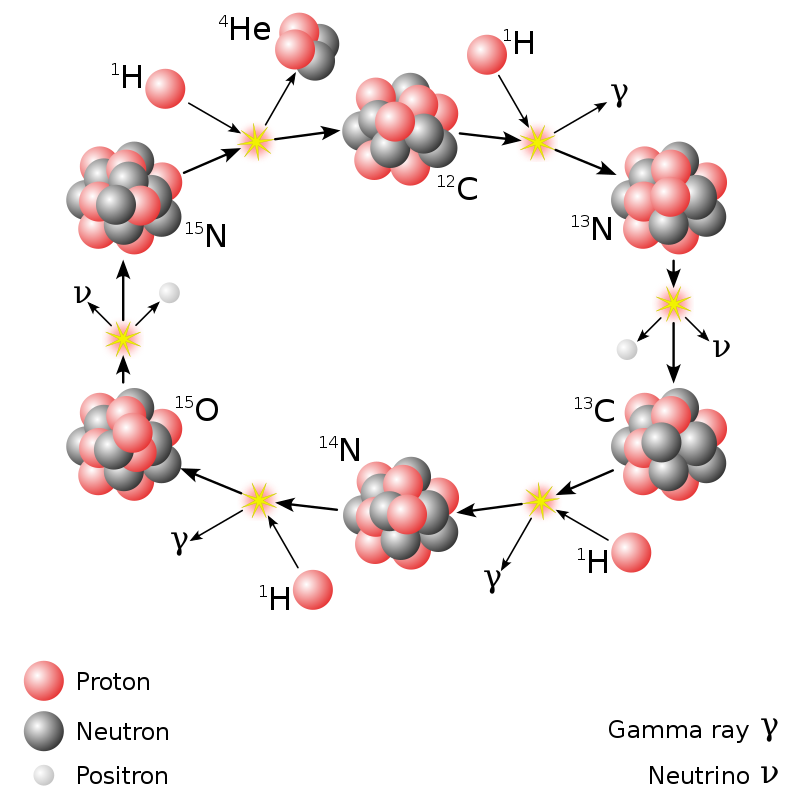
(좌)태양 크기의 별에서 핵융합반응은 4개의 수소(프로톤)에서 1개의 헬륨이 만들어진다. (우) 무거운 별의 핵융합은 탄소-질소-산소(CNO) 순환 반응이다. [참고: Nuclear Fusion]

For main sequence stars, there's a strong relationship between mass and luminosity. The more mass of the star, the brighter it is. The intense gravity of a massive star means its core will be denser and as a result, hotter. This is important because fusion rates, meaning the rate at which energy is produced, is highly dependent on core temperature. So, the more mass of a star, the more energy per unit time it produces and as this energy leaves the core and eventually reaches the surface, we observe a greater luminosity, meaning a brighter star.

주계열별의 질량과 밝기에 밀접한 관계가 있다. 무거운 별의 중심에는 강력한 중력으로 인해 연료의 밀도가 높아져서 더욱 뜨겁다. 활발한 핵융합 활동으로 더많은 에너지가 생산되며 중심온도도 높아진다. 결국 더 많은 에너지가 생산되어 표면으로 전달된 에너지는 더  밝은 별이 된다. 물론 무거운 별일 수록 반경이 길고 빛이 나오는 표면적도 넓다.

You'll notice in taking this course that we often refer to stars by their color. So when we say color, what do we mean? Well, as we learned in module one, electromagnetic radiation or light is a spectrum, visible light being just one portion of it. What we call blue is just an even smaller portion of the spectrum. Instead of simply calling it blue, we could define it in numbers because as we know, light is characterized by its wavelength. Blue light has a wavelength of about 450 nanometers. So when we refer to a blue star, what we are saying is that much of its radiation is coming from this portion of the spectrum. When we say a star is bluer than another star, what we mean is that the bulk of the bluer star's radiation is coming from even shorter wavelength light. The same can be said of red and redder stars. As a redder star will have the bulk of its radiation in longer wavelength light.

별의 표면 온도는 색으로 알 수 있다. 파장이 짧을수록 높은 에너지를 방출하고(표면온도가 높고) 파장이 길 수록 에너지 방출량이 작다(온도가 낮다).

Just like the filament of a light bulb, a star's light is produced by incandescence or formally, blackbody radiation. Blackbody radiation is temperature dependent. The hotter a blackbody radiator is, the brighter it is. As the temperature of a blackbody emitter increases or decreases, it also changes color. This is why colder stars appear dim and red, and hotter stars are brighter and bluer. The hottest stars in the sky, blue hyper-giants are upwards of 40,000 degrees centigrade and can shine about five million times brighter than our own sun. We say that hotter stars are blue and the colder stars are red but the reality with blackbody radiation is that every star produces at least a little bit of every color of the spectrum.

When we say a star is blue, we're saying that the majority of its radiation is being produced in this portion of the spectrum. This majority exists because each blackbody emitter has a spectrum that is peaked. Meaning there's a wavelength at which the star produces more light than at any other wavelength. These peak wavelength are directly related to the surface temperature of a star.

The relationship is described by Wien's law which takes the form of this equation. The peak wavelength Lambda peak is equal to 0.0029 meters Kelvin divided by the temperature T of the blackbody emitter.


별의 복사(에너지 방출)를 흑체복사라 하며 온도와 방출되는 빛의 파장은 관계를 비인법칙(Wein's Law)으로 잘 알려져 있다. 흑체복사는 모든 파장의 빛이 방출되지만 온도가 높을 수록 지배하는 파장이  짧아진다. 온도가 높을 수록 방출되는 에너지도 많지만 최대 방출 빛의 파장도 변한다. [참고: 빈 변위 법칙]


As we mentioned earlier, more massive stars are brighter because they're more luminous as a result of having higher fusion rates. Despite having more material to burn, more massive stars live shorter lives. The more massive a main sequence star is, the quicker it exhaust the fuel in its core. Hot blue star might live on the main sequence for 10 million years whereas the dim red star could live as long or longer than a trillion years, that's 100,000 times longer. This is why we like to personify stars. We'd like to think of blue stars as rock stars that live fast and die young. Red stars live long and much more uneventful lives.


무거운 별은 중심부의 핵융합 반응이 활발하기 때문에 밝고 푸르다. 그만큼 연료를 빨리 태우기 때문에 주계열에 머무는 수명이 천만년 가량으로 짧다. 이에 비해 어두운 붉은 색 별의 주계열 수명은 1천조년(trillion years)으로 십만배 가량 더 오래 지속된다. [우주나이보다 더 오래 산다.] 파란(청색)별은 파란만장한(질풍노도의) 삶을 살다 일찍 죽는다. 붉은 별은 부침 없이 장수한다.

At midday, there's one star visible to our eyes, the sun. At this point, you might be wondering where the sun lies on an HR diagram. Meaning how does it compare to other stars? Well, the sun happens to be pretty average. It's not terribly hot or particularly cold. The sun's spectrum peaks at a wavelength of about 500 nanometers, which is greenish. It appears whitish or yellowish to our eyes because it is emitting a lot of light across the entire visible spectrum.


태양은 아주 평범한  주계열 별로 최고세기 파장은 약간 녹색이다. 하지만 워낙 가깝고 전파장대의 가시광선 빛이 나오기 때문에 붉게 보인다. [뜨거움을 붉게 표현하는 인간의 감성 탓도 있다.]

In terms of mass, the sun lies fairly close to the lower end of what's possible for a main sequence star. At the high end, massive blue stars can be a couple of 100 times as massive as our sun. At the low end, a red main sequence star can be as massive as a 10th of our sun.

태양의 질량은 주계열 별의 중심에서 약간 가벼운 쪽이다. 주계열 별에서 무거운 청색별은 태양의 100배, 어두운 적색별은 10분의 일 가량된다.

-------------------------------

The most massive star that is currently known lives at the edge of our galaxy. Scientists have given it the name R136A1, but we call it Rob. Rob has been measured at a whopping 256 solar masses. However, Rob has lost a great deal of material through fusion and winds and it's thought that 20 percent of its mass has been ejected already. This would mean that at birth Rob was about 320 solar masses. In terms of luminosity, the sun is fairly average. Blue stars can be several million times as luminous as our sun and red stars can be much dimmer such that their luminosity is only a ten-thousandth that of our sun.


무거운 별들은 은하의 외곽에 위치한다. 우리 은하중 관측된 가장 무거운 별은 R136a1 이다. '롭' 이라는 애칭이 붙은 이 별은 태양의 236배나 무겁다. 롭은 현재 대부분의 핵융합 연료를 소진하고 찌꺼기들을 날려버렸을 것으로 추측된다. 현재 20% 가량을 잃었을 것으로 예상된다. 롭이 태어났을 때는 태양의 320배가량의 무게를 가졌을 것으로 추측된다.

----------------------------------

One of the difficulties associated with constructing an HR diagram of a population of stars is figuring out how bright the stars actually are versus how bright they look to us in the night sky. Luminosity is a measure of how bright a star actually is. Apparent brightness is how bright a star will look to us. Apparent brightness is affected by distance because the further away a star is, the dimmer it will appear to be and we're not interested strictly in appearances.

We want to be able to infer characteristics of the stars themselves. What we need to do then is measure a star's brightness knowing already how far it is from us, that way we can correct for its appearance meaning its distance and compare it fairly to other stars. Astronomers have spent hundreds of years constructing catalogs of objects with known properties, distances, and luminosities so that when we discover new objects, we can know much more about them.

Being able to measure apparent brightness and distance accurately is very important. It means that we can construct an accurate HR diagram and that's crucial because an HR diagram is a tool which allows us to learn even more, specifically, characteristics about an entire population of stars.

For instance, we can use an HR diagram to learn about the age of a population of stars. We can do this by determining the main sequence turnoff point. As a star exhaust the hydrogen fuel supply in its core, its time on the main sequence ends. This is because the surface of the star cools as its core runs out of fuel and so it moves rightward on the HR diagram away from that diagonal swath of stars.


Imagine we have a population of stars with a large variety of masses, all born at roughly the same time. Hot blue stars, if you remember, live fast and die young. In other words, the stars in the high temperature, high luminosity region of the diagram will exhaust the fuel in their course first, they will move off the main sequence and continue with the later stages of their lives. Next to move off the main sequence will be stars which are slightly less massive than those first stars because, as you remember, the lower the mass of the star, the longer its main sequence lifetime. Over time, the main sequence will be slowly eaten away as less and less massive stars begin to move away. The points along the main sequence where stars are departing is called the main sequence turnoff point. We can measure the properties of the stars at this point and because we know how long every type of main sequence star typically lives, we can learn the age of the entire population of stars.

[참고]
자료기반 천문학: 4주/2강: 별의 탄생과 죽음의 과정
자료기반 천문학: 4주/4강: 성단 탐구
[AstroTech/2째주] 4. 우주사진 찍기


-----------------------------------------
[처음][이전][다음]

02.02 - 별이 태어나는 곳(The Stellar Nursery)

02.02 - 별이 태어나는 곳(The Stellar Nursery) [커세라 강의페이지]


In order to fully understand the story of black holes, it's important that we start at the beginning. To know why black holes are formed, we must first understand why the objects, that form black holes, are formed.

블랙홀을 완전히 이해하기 위해서 별이 생겨난 시점부터 시작하자. 블랙홀이 어떻게 만들어지는지 알기위해 어떤 천체(별)가 블랙홀로 연결되는지 알아야 한다.

As stated in the introduction to this module, stellar mass black holes are one of the two possible products of violent explosions of high mass stars, which occur at the end of the star's life. These explosions, called Type-II or Core-Collapse Supernovae, occur in stars at least eight times more massive than our sun. When a massive star experiences a supernova event, the amount of energy released is on the order of 10 to the 46 joules. That's enough energy to last the sun, at its present rate of energy output, 825 billion years. For reference, our solar system, along with our sun, has existed for just 5 billion years. The universe has existed for a mere 13.8 billion years. Clearly, that is a huge amount of energy.


별 질량 블랙홀은 블랙홀이 만들어지는 두가지 가능성 중의 하나다. 높은 질량의 별의 마지막 시기에 급격한 폭발로 이어진다. 이 폭발을 2형 혹은 핵 축퇴형 초신성이라고 한다. 적어도 태양 질량의 여덟배 되는 별이어야 한다. 무거운 별이 초신성으로 이어질 때 쏟아지는 에너지량은 10의 46승 주울 가량이다. 이정도의 에너지량은 현재의 태양이 8천2백5십억년동안 내는 에너지량과 같다. 참고로 우리 태양계의 나이는 약 50억년이다. 우주의 나이는 138억년이다. 확실히 초신성이 내는 에너지는 엄청나다. [초신성의 폭발로 인한 밝기는 은하의 밝기에 버금간다.][참고: Supernova]


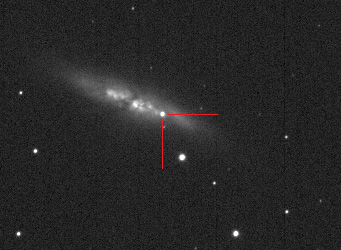
SN2014J / Supernova in M82[link]

If you're anything like me, right now you'd have a ton of questions, starting with, how is it that some stars meet such violent ends? How do stars even form in the first place? Technically speaking, what is a star?

이 시점에서 많은 질문이 나올법 하다. 어떤 별이 그런 엄청난 폭발을 일으킬까? 무엇보다도 별은 어떻게 시작될까? 구체적으로 별이란 무엇인가?

Let's begin by answering the simplest of those questions, what is a star? Simply put, a star is a big ball of gas. A ball of gas which is gravitationally bound, and dense and hot enough, to sustain a nuclear fusion reaction at its core. Our sun is one such object. It, like all of the main sequence stars, produces energy by fusing hydrogen into helium in its core. Most stars are spherical or, if they happen to rotate quite quickly, we call then oblate spheroidal because they're slightly squished.


'별(항성)'을 간단히 말하면 커다란 가스 공이다. 중심에 핵융합을 일으키기에 충분한 중력으로 뭉친 뜨겁고 밀집된 가스 공이다. 우리의 태양도 그중 하나인데 평범한 주계열 별로 중심에서 수소 핵융합으로 헬륨을 만들고 있다.  대부분 별은 구형 이거나 빠르게 자전하기 때문에 약간 짜브러져있다.

So now that we have a working definition of what a star is, let's move on to the next question. How do stars form? Stars form in clouds of gas and dust which are particularly cold and dense, at least by interstellar standard. These regions are known as molecular clouds, because their temperatures are low enough to allow molecules to form. Molecular clouds are just one component of all the gas and dust in the space between the stars, known as the Interstellar Medium or ISM.

이제 별의 정의를 내렸으니 이제 다음 질문으로 넘어가 보자. 별은 어떻게 형성될까? 별은 차갑고 밀집된 가스와 먼지 구름 속에서 만들어진다. 이 영역을 분자구름으로 알려졌는데 분자들이 뭉칠만큼 충분히 온도가 낮다. 분자구름은 별들 사이의 먼지와 가스 뭉치들인데 성간물질(ISM; Interstellar Medium)이라고 한다.


What distinguishes molecular clouds from other gas and dust in the ISM is the effect gravity has on them. Molecular clouds are cold, between ten and thirty kelvin. And dense, several hundred molecules per cubic centimeter. Meaning there are plenty of particles in close proximity to each other, at the same time, relatively little gas pressure. These two conditions are each very important for star formation, as they allow the inward force of gravity to overpower the outward force of the gas pressure, and initiate the collapse of the cloud.

분자구름이 성간물질에서 다른 먼지와 가스와 차이는 중력의 영향으로 뭉칠 수 있다는 점이다. 분자구름의 온도는 10~30K(켈빈, 절대온도)가량된다. [온도가 높으면 분자들의 활동이 높아 뭉칠 수 없다.] 이 분자구름의 밀도는 10 입방 센티미터당 수백개의 분자가 존재한다. 분자들 사이의 (분자들 사이의 인력이 작용할 만큼) 거리가 가깝고 동시에 가스압력도 상대적으로 낮다. (분자 사이의) 뭉치는 중력이 떨어지는 가스 압력보다 높아야 하는 이 두가지 조건은 별 형성에 매우 중요하며  먼지구름들이 뭉치기 시작한다.

As the cloud contracts, it releases gravitational potential energy. This energy is converted into thermal energy, which in turn, increases the pressure within the gas. Without some way of removing thermal energy, the gas pressure would build and eventually stop contraction of the cloud all together, prior to the formation of the star.

일단 먼지구름이 뭉치기 시작하면 중력 포텐셜 에너지가 생기기 시작한다. 이 중력 에너지는 열 에너지로 변하여 가스압을 높인다. 열 에너지를 소멸하는 방법이 따로 없으므로 (열로인한) 가스압이 증가하여 마침내 먼지 수축이 정지하면 비로서 별의 생성 전단계에 이른다.

What is needed then, is a way to get energy out. A way to get energy out so that gravity still has the advantage, and contraction can continue. Thermal energy manifests itself in the random motions and frequent collisions of molecules. Collisions between molecules and the gas can excite the molecules, allowing them produce light that can escape the cloud. And so without a buildup of thermal energy and gas pressure the cloud is free to continue contracting.

이제 중력수축으로 발생된 에너지를 배출할 방법이 필요하다. 중력수축으로 발생한 열 에너지에 의해 분자들 사이에 충돌이 활발해지며 그로인해 들뜬 분자들이 빛을 내고 그 빛은 분자구름 밖으로 새어나온다. 비로서 열에너지와 가스압의 축적이 사라지고 계속해서 중력수축이 진행된다.


However, as contraction continues, the central region within the cloud eventually becomes so dense that light emitted by molecules and by dust grains has a hard time escaping. More particles present in a given volume of the cloud means an increased likelihood of absorption of the light by other molecules, and subsequent conversion of that energy back into thermal energy. Over time, the cloud's increasing density will result in nearly all of the radiation being trapped with in the central region of the cloud. When this radiation trapping occurs pressure in the central region increases to a level which slows the rate of contraction. This is the formation of a protostar.

수축이 진행되면서 중심부의 분자밀도가 매우 증가하여 흥분된 분자에서 방출된 빛이 밖으로 빠져나오기 어렵게 된다. 결국 열 에너지의 증가로 이어지다 중심온도가 급격히 증가하는데 이렇게 형성된 천체를 원시별(proto-star)라 한다.

When observed through telescopes, protostars look much the same as regular stars, in that they have similar luminosities and surface temperatures. The difference lies underneath, as protostars are not yet hot enough to sustain fusion reactions. In order to become hot enough to sustain fusion, protostars must gather more material and squish it. Material surrounding the protostar feeds down onto it. And at the same time, gravity continues to slowly squish this proto-stellar material into smaller and smaller regions. As the protostar contracts and heats, the fusion rate increases. And the heat generated by these nuclear reactions provides a pressure force that slows the contraction, caused by gravity. When the core temperature of the protostar reaches about a million Kelvin, the winds generated at the protostar's surface, blows the surrounding gas and dust away, ending the accretion phase.

원시별을 망원경으로 관측하면 보통 별과 비슷한 모습이다. 하지만 원시별은 아직 핵융합이 시작되지 못했다. 더 많은 물질들이 원시별 주변에 모인다. 아울러 중력이 서서히 중심부를 쥐어짠다. 마침내 중심부 온도가 백만 켈빈에 이르면 원시별 표면에 모여든 가스와 먼지들을 밖으로 불어내는데 강착(행성 가스들이 들어붙음) 단계에 이른다.

Now without it's source of additional material, the protostar continues to slowly contract and heat until the core temperature reaches 10 million Kelvin. At which point fusion becomes stable, and we have a star. Fusion rates become stable because the forces in the interior of the star become balanced. Nuclear reaction rate are now high enough that they produce the necessary heat and pressure to prevent the star from collapsing further due to gravity. When the gravity and gas pressure forces are in balance we call this state Hydrostatic Equilibrium. The net force on material within the star is zero. The star can remain stable in this state for billions of years. Our sun is currently about 5 billion years old and in a state of hydrostatic equilibrium. It will remain in this stable state for another 5 billion years.


이제 별도의  물질이 없이도 원시별은 수축하다 중심 온도가 천만 켈빈에 이르면 핵융합이 안정되면서 별이된다. 핵융합으로 발생한 에너지는 중력 수축과 균형을 이뤄 별(항성)이된다. 중력 수축과 핵융합에의한 가스압이 균형을 이룬 상태를 정역학 평형(Hydrostatic Equilibrium)에 있다고 한다. 별은 이상태로 수십억년을 보낸다. 우리 태양은 정역학 평형상태로 지낸지 50억년 됐다. 앞으로 50억년 더 이대로 지내게 될 것이다.

It's time again for us to confess about a lie of omission we've been telling. Until this point, we've been considering a scenario of star formation which isn't perfectly realistic. We've been considering a single cloud in isolation when in reality, individual sites of star formation are often influenced by other nearby sites of formation, and by nearby newborn stars. In truth, large molecular clouds fragment as they contract into several smaller cloud cores, and from these, one or more stars form. Often what we have is several neighboring sites, potentially each producing several stars. And then there's the matter of those additional dynamical aspects we also forgot to mention. More than just two forces are present in molecular clouds as they contract.

지금가지 논한 별의 탄생과정은 매우 이상적인 경우라는 점을 밝혀둔다. 광범위하게 퍼져있는 성간먼지중에 별이 단하나 만들어진다고 단정 할 수 없다. 별을 만들어낼 다른 강력한 요인이 있을 수 있다. 분자구름이 수축할 때 단 두가지 힘(중력과 가스압)만 작용할 것이라고 가정할 분명한 근거는 없다.

In addition to gravity and gas pressure, magnetic fields affect molecular clouds by slowing their contraction. Magnetic fields cause particles in a cloud to move in such a way that they exert a friction on each other. Hindering motion within the gas and helping to prop up the cloud against gravity. Turbulence also plays an important role. Gas clumps moving relative to each other at large speeds act to shear the cloud apart. Rather than facilitate the cloud's contraction. In the later stages of star formation, materials surrounding the protostar will coalesce into a disc, and the protostar itself will eject material from the system, via large jets. So, suffice to say, star formation is very complex. But star formation is also incredibly common place. Several stars finish forming in our galaxy every year. And in total our galaxy contains roughly 100 billion stars.


중력과 가스압 외에 (이온화된)분자들에 의해 형성되는 자기장도 수축을 방해하는 요인이 된다. 분자운동 도한 중력 수축에 반하여 작용한다. 분자의 빠른 움직임과 분자구름의 난류형성도 방해요소다. 별이되기 직전의 원시별을 둘러싼 물질들이 원반을 형성하고 (빠르게 회전하여) 물질들을 분출하기도 한다. 별의 형성과정은 매우 복잡하다. [별의 형성은 매우 낮은 확률의 우연에 가깝다. 여러 조건이 매우 이상적으로 맞아야 한다.] 어쨌든 별은 지금도 매우 다양한 장소에서 태어나고 있다. 우리 은하에는 약 천억개의 별이 있다.


And the key to our final question, how do some stars meet such violent ends? Lies in the variety of stars which result from the formation scenario.

이제 마지막 질문이다. 어떤 별이 폭발을 하는 것일까? 별의 탄생 과정에서부터 다양한 운명을 가지고 태어난다.

-----------------------------------------
[처음][이전][다음]